F Plus Healthcare Technologies | Insights for Pharma Manufacturers
A single tablet coating defect can scrap an entire batch. With highly potent APIs, it can also expose your operators. What began as a cosmetic finish in the 1950s has become the most regulated, instrumented step on a tablet line directly affecting bioavailability, patient compliance, and regulatory approval.
This blog tracks how tablet coating evolved from sugar pans to closed loop pharma auto coaters, and explains why the technology you choose today decides your yield, compliance, and operator safety tomorrow.
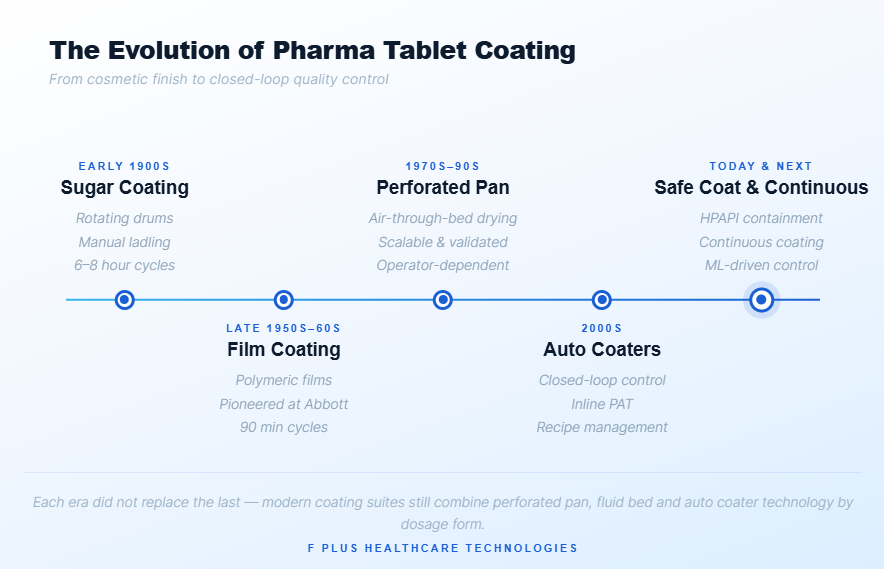
Figure 1: The evolution of pharma tablet coating : five eras of process control.
Why Coating Decides Your Film Coated Tablet’s Fate
Coating used to be a finishing flourish. Today it is a quality determining step. A modern film coat does four things at once: it masks taste, protects the API from moisture and light, controls drug release, and carries the brand identity into the patient’s hand.
Get it wrong, and you face stability failures, dissolution variability, and batch rejection. Get it right, and the coating becomes invisible to the patient exactly as it should be.
Sugar Coating: Where It All Began
For most of the twentieth century, sugar coating was the industry standard. Tablets tumbled in simple rotating drums while operators ladled sugar syrup over them in successive layers. The output was visually striking and effective at masking bitter APIs.
It was a slow, labour intensive coating process. Moreover, it was difficult to reproduce batch to batch. As pharma scaled, sugar coating could no longer keep up with demands for consistency, control, and throughput.
The Film Coating Revolution
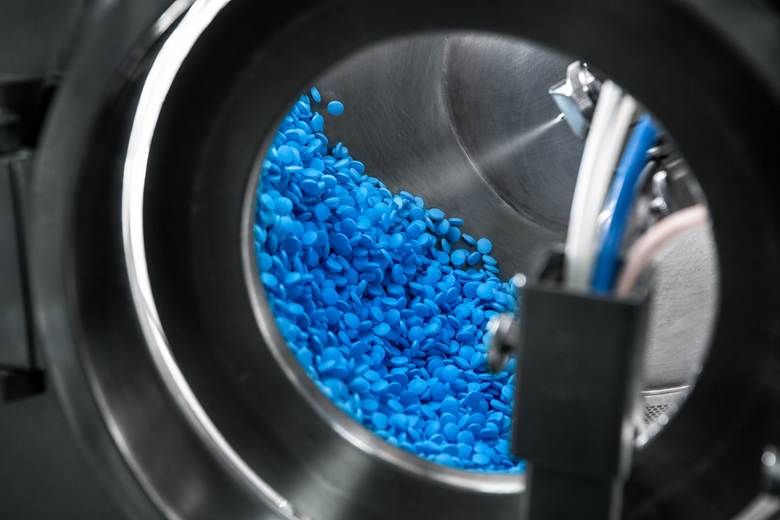
In the late 1950s and early 1960s, polymeric film coating pioneered at Abbott Laboratories changed the category permanently. By spraying thin, uniform films onto tumbling tablets, manufacturers achieved functional and protective coatings in a fraction of the time, with far greater control over thickness and weight gain.
Film coating remains the dominant method on the market today. Every modern tablet coater perforated pan, fluid bed, or fully automatic Autocoaters is a refinement of this core principle.
Perforated Pan Coaters
The perforated pan coater took the film coating principle and engineered it into a controlled, scalable system. Air enters through the pan, passes through the tablet bed, and exits through perforations drying the film as it is applied.
Perforated pan coaters are still the backbone of most coating suites. They are well understood, well validated, and serviceable. Their limitation is operator dependency: even with good design, batch-to-batch consistency relies heavily on the skill of the operator running the cycle.
Fluidized Bed Coaters
Fluidized bed systems were not introduced to replace pan coaters. They were built for a different formulation challenge coating pellets, granules, and small particles where tumbling in a pan is not viable.They sit alongside pan coaters in a modern pharma facility, not above or below them. The right question is never “pan or fluid bed? it is “which is right for this dosage form?
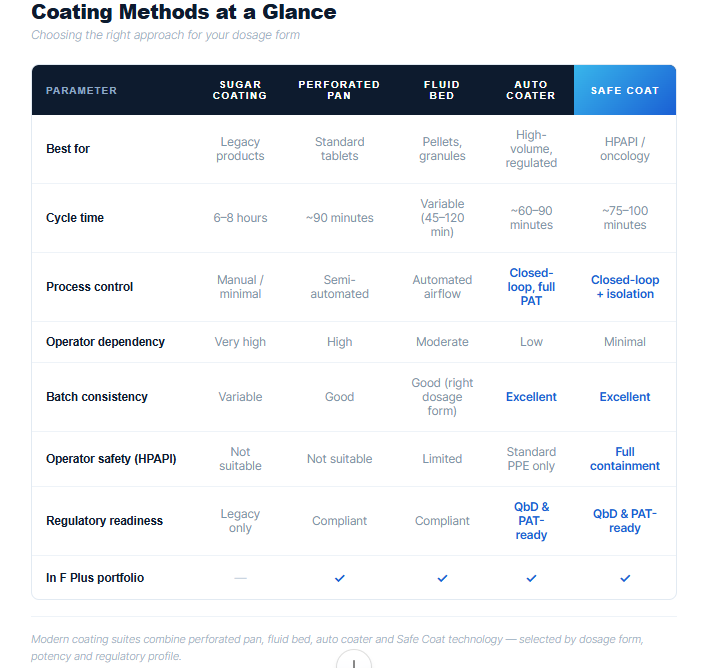
Figure 2: Coating methods at a glance: selecting by dosage form, potency, and regulatory profile.
The Auto-Coater Era: What “Automation” Actually Means
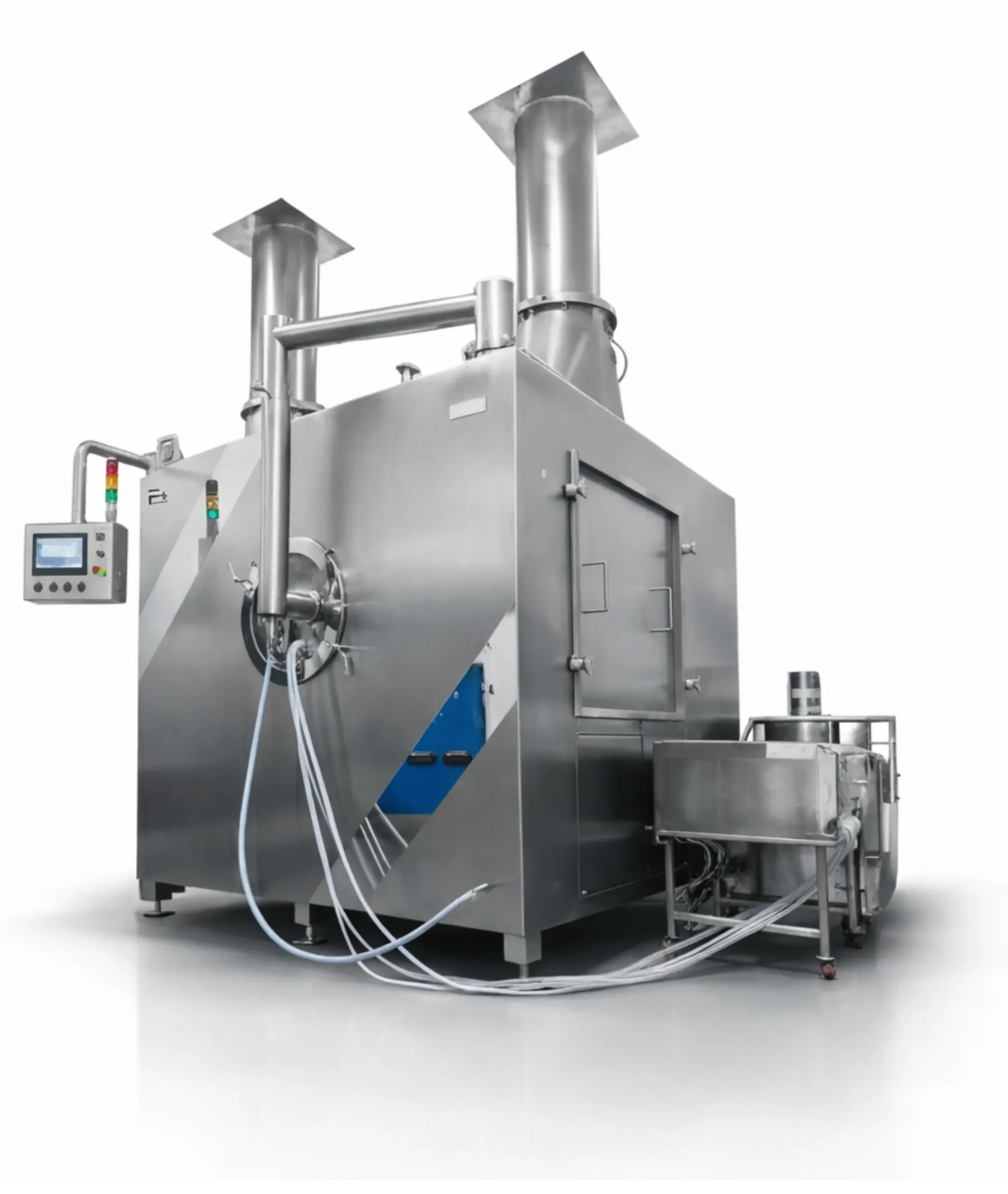
Automation in tablet coating is not a new machine type. It is a deeper layer of control built onto the perforated pan platform. A fully automatic coater controls every variable of the cycle, in real time, with minimal operator input.
Modern pharma auto coaters integrate four capabilities that earlier systems could not deliver together:
- Closed-loop control: spray rate, pan speed, inlet temperature, and exhaust conditions adjusted continuously to hold the process inside its design window.
- Inline PAT tools: weight gain, coating thickness, and uniformity measured non-destructively during the process without any offline sampling.
- Automated recipe management: electronic batch records, audit-ready data, and one-click reproducibility across operators and shifts.
- Scalable design: consistent performance from pilot batch to commercial scale, with minimal re-validation between sizes.
- Multi-coating option: A single machine is capable to perform Film, enteric and Sugar coating using change-parts.
At F Plus, our pharma auto coaters are built to a single principle: every batch should be the most consistent batch you have ever run, regardless of who is on the floor that night.
Safe Coat: When Potency Demands Containment
The pharma pipeline has shifted toward highly potent active pharmaceutical ingredients (HPAPIs): oncology, hormones, and targeted therapies. These molecules are effective at microgram doses, and they are dangerous to operators in equally small amounts.
Standard coating equipment cannot handle them safely. Containment coaters, also called Safe Coat systems are fully enclosed, negativepressure machines that protect operators from airborne potent dust through the entire cycle, including charging, coating, discharge, and cleaning.
If your pipeline includes any HPAPI work, even one product in five, your coating line needs to be designed for it from day one. Retrofitting containment is always more expensive than specifying it correctly the first time.
What’s Next: Continuous Coating and Intelligent Control
Two trends will define the next decade of tablet coating.
First, continuous manufacturing. Regulatory agencies, especially the US-FDA in particular have actively encouraged the shift from batch to continuous processing. For film coated tablets , this means tablets flow through the system in a continuous stream, with PAT tools maintaining quality in real time. The economic case is strong: smaller footprint, less inventory, faster scale-up.
Second, intelligent process control. Automatic tablet coating machines are starting to use machine learning on historical batch data to predict deviations before they occur. The next generation of equipment will not just react to process drift, it will anticipate it.
Both trends are converging on the same outcome: tablet coating that is faster, more consistent, and more transparent to regulators.
Why This Matters for Your Tablet Coating Line
If you are running a conventional perforated pan coater that is more than ten years old, you are likely losing yield on every batch to over-coating, under coating, and inconsistent weight gain. You are also generating more manual quality data than your team has time to analyse.
The case for upgrading is rarely about a single feature. It is about closing the gap between what your process can do today and what your regulators, your customers, and your own pipeline will demand five years from now.
CTA: If your coating line is the bottleneck on your tablet floor or if HPAPI products are coming into your pipeline – talk to us. A short call usually clarifies the path forward.
The F Plus Approach
F Plus Healthcare Technologies designs and delivers tailor made coating systems for pharma manufacturers across South Asia, Southeast Asia, and beyond. Our coating portfolio covers standard pharma auto coaters, Safe Coat containment systems, and full integration with upstream granulation and downstream packaging lines.
We are not a catalogue supplier. Every coater we deliver is configured to your product, your facility, and your scale up roadmap. Our Plus Team engineers who stay with you from process design through SAT and beyond. This is the core difference between buying equipment and building capability.
To explore the F Plus auto coater range, write to info@fplushealthcare.com
FAQs
1. What is tablet coating in pharmaceutical manufacturing?
Tablet coating is the process of applying a thin layer of coating material to a tablet to mask taste, protect the API from moisture and light, control drug release, and ensure stability. In modern pharma, it is a quality-determining step, not a cosmetic one.
2. What are the main types of tablet coating methods?
The three main methods in commercial use today are sugar coating (largely legacy), film coating in perforated pan coaters (the industry workhorse), and fluidized bed coating (used for pellets, granules, and specialised dosage forms). Film coating in fully automatic perforated pan systems is the dominant approach for most modern tablet products.
3. What is an automatic tablet coating machine?
An automatic tablet coating machine is a perforated pan coater with closed-loop control over every critical process variable spray rate, pan speed, airflow, and temperature combined with inline PAT tools and automated recipe management. F Plus auto coaters are designed to deliver consistent batches with minimal operator intervention, full audit trails, and seamless scale-up from pilot to commercial.
4. Why is film coating preferred over sugar coating?
Film coating is faster, far more consistent, and gives precise control over coating thickness and drug release. A sugar coating cycle that took six to eight hours can now be completed as a film coat in under ninety minutes, with better reproducibility and a fraction of the operator effort.
5. What is the role of PAT and QbD in tablet coating?
Process Analytical Technology (PAT) and Quality by Design (QbD) move quality control from end-of-batch testing into real-time process control. In coating, this means weight gain and uniformity are monitored continuously rather than sampled afterwards. F Plus auto coaters are built with PAT integration as standard, supporting both regulatory expectations and the shift toward continuous manufacturing.
Ready to upgrade your coating line?
Talk to the F Plus Plus Team. Tailor made. Integrated. Built to scale.