
Introduction
In pharmaceutical granulation, process performance depends on more than the individual machines involved. The transitions between granulation, milling, and drying can significantly influence material consistency, granule quality, and downstream processing.
Each operation is designed to achieve a specific outcome, but its effectiveness also depends on the condition of the material it receives. Variations in wet mass consistency, particle size distribution, and moisture content can influence the performance of subsequent stages.
Understanding these transfer points is essential to developing a granulation workflow in which individual operations function as part of a coordinated process.
Why Transfer Points Matter in Granulation
Granulation is a sequence of interconnected operations. Material characteristics established at one stage become the starting conditions for the next, making process compatibility a critical consideration.
When transitions between stages are not adequately considered, manufacturers may encounter inconsistent feeding, material accumulation, variations in particle size, or differences in moisture distribution. These challenges can affect process efficiency and introduce variability into the final granule profile.
The issue is not always the performance of an individual machine. It may also lie in the relationship between the output of one operation and the requirements of the next.
A well-engineered granulation workflow therefore considers not only what each machine must achieve, but also how the material should behave as it moves through the process.
Granulation to Wet Milling: Managing Wet Mass Characteristics
Following wet granulation, the material must be suitable for subsequent size reduction. Its consistency, moisture level, and degree of agglomeration influence how effectively it passes through the wet mill.
A highly cohesive wet mass may create feeding difficulties or material accumulation, insufficiently developed granules may respond differently during milling. Both conditions can affect the resulting particle size distribution.
The interaction between the rapid mixer granulator (RMG) and wet mill is therefore an important consideration in process design.
Key factors include:
- Wet mass consistency: Influences material feeding and milling behaviour.
- Granule strength and cohesion: Determine how agglomerates respond to size reduction.
- Mill configuration: Screen selection and operating parameters influence the resulting particle size profile.
- Process coordination: The granulation output should be compatible with the wet mill’s operating requirements.
The objective is to achieve effective size reduction while maintaining the material characteristics required for subsequent drying. This requires the granulation and milling stages to be considered together rather than optimized independently.
Wet Milling to Fluid Bed Drying: Preparing Material for Uniform Drying
After wet milling, the material proceeds to drying, where moisture must be reduced to the specified level. At this stage, particle size distribution, initial moisture content, and feed consistency can influence drying behaviour.
Differences in particle size may affect fluidization, while variations in moisture can influence the drying load and the time required to reach the target endpoint. An inconsistent feed may also contribute to fluctuations in operating conditions.
The transition from wet milling to a fluid bed dryer (FBD) should therefore be designed around the characteristics of the processed material and the requirements of the drying operation.
Important considerations include:
- Particle size distribution: Influences how material behaves during fluidization.
- Initial moisture content: Affects the drying load and process duration.
- Feed consistency: Supports stable operating conditions within the dryer.
- Drying parameters: Airflow, temperature, and other process settings must suit the material being processed.
When these factors are considered together, the drying stage can be better aligned with the material received from wet milling, supporting more predictable process performance.
Drying to Dry Milling: Achieving the Required Granule Profile
Depending on the formulation and manufacturing requirements, dried granules may undergo an additional milling stage to achieve the desired particle size distribution.
The condition of the dried material influences how it responds to size reduction. Differences in residual moisture and granule strength can affect milling behaviour, potentially influencing fines generation and the uniformity of the final granule profile.
The relationship between the fluid bed dryer and dry mill should therefore be established with the intended downstream application in mind.
Key considerations include:
- Residual moisture: Influences granule strength and milling behaviour.
- Granule integrity: Affects the balance between size reduction and fines generation.
- Mill configuration: Screen selection and operating conditions help determine the final particle size profile.
- Downstream requirements: Granule characteristics should suit subsequent blending, tablet compression or capsule filling operations.
The aim is to obtain the required particle size without introducing unnecessary variation that could compromise the next stage of manufacturing.
Designing for an Integrated Granulation Workflow
An integrated granulation line must be designed around the relationship between its processing stages. Selecting machines based solely on individual specifications can overlook the interactions that influence overall process performance.
Several considerations are important when developing the workflow.
Material and formulation requirements
The formulation’s physical properties, moisture behaviour, and granulation characteristics should inform equipment selection and process configuration.
Equipment compatibility
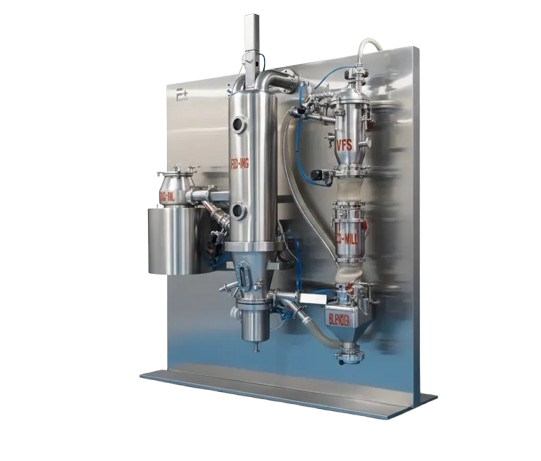
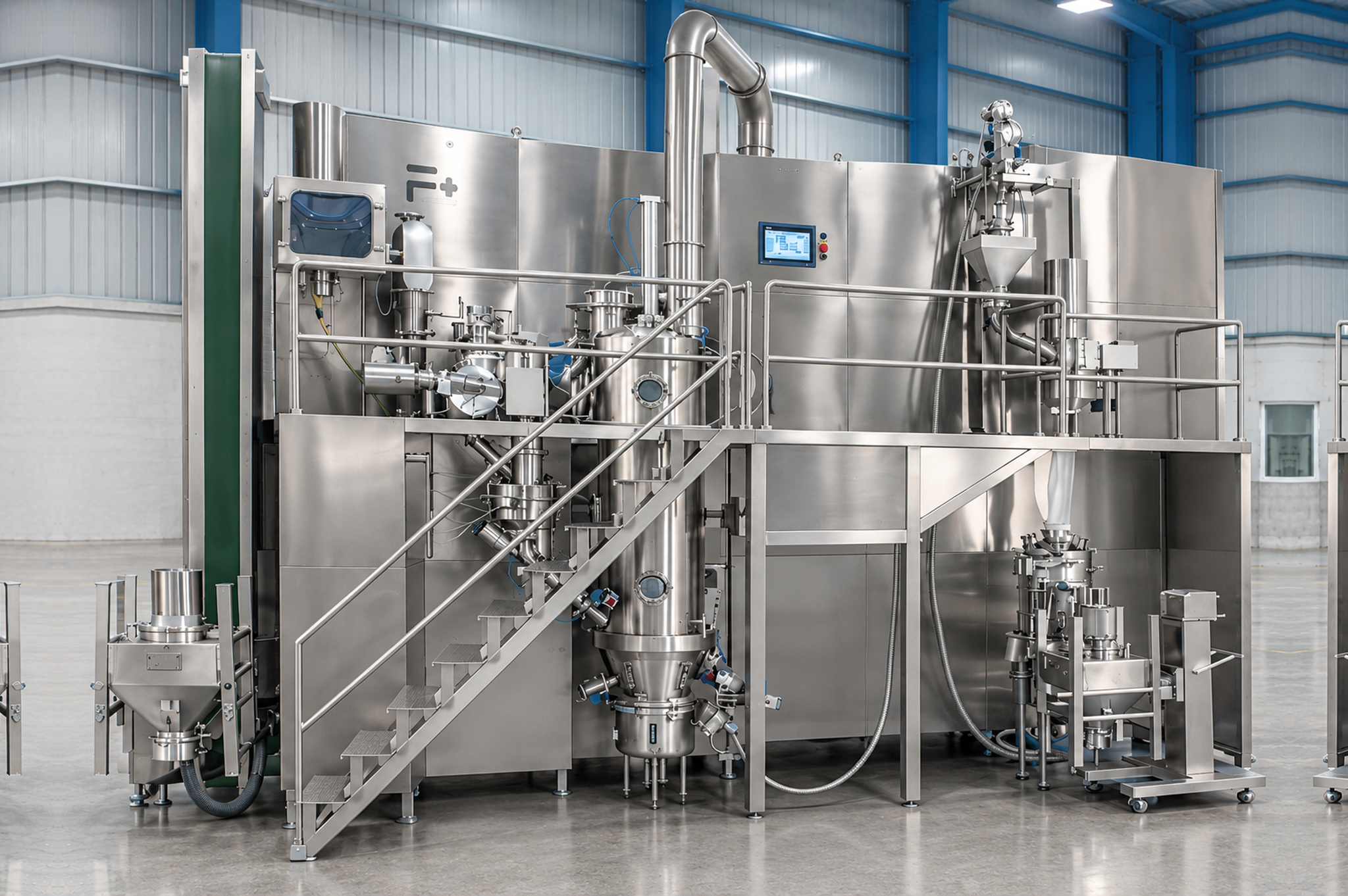
The RMG, wet mill, FBD, and dry mill should be evaluated as components of the same production sequence. Their capacities, operating requirements, and process interfaces must be suitable for the intended workflow.
Process parameter alignment
Critical parameters across the stages should be established in relation to one another. For example, the characteristics of the wet mass influence milling, while the output of milling affects the conditions required for effective drying.
Production continuity
The arrangement of equipment and material transfer points should support a practical production sequence, with attention to feeding, discharge, accessibility, and avoidable process interruptions.
Final product requirements
The desired granule properties should be defined with the downstream manufacturing process in mind. This helps connect equipment selection and process configuration to the requirements of the final dosage form.
Considering these factors at the design stage allows manufacturers to evaluate the granulation line as a complete process rather than a collection of individual machines.
The F Plus Approach
At F Plus Healthcare, granulation line development begins with understanding the product, the intended manufacturing scale and the process requirements. Equipment configuration is then considered in the context of the overall production objective, supporting a solution tailored to the application’s specific needs. By taking a process-led engineering approach, F Plus aims to align granulation technology with practical manufacturing demands and long-term production goals.
FAQs
1. Can a granulation line be configured for different batch sizes?
Yes. The configuration depends on the required production capacity, formulation characteristics, equipment capabilities, and flexibility needed for different products or batch sizes.
2. Should wet milling capacity be matched to the output of the rapid mixer granulator?
Yes. Wet mill capacity should be evaluated against the RMG’s discharge characteristics, batch size, and expected processing time. A mismatch can create a bottleneck between granulation and subsequent operations.
3. What should manufacturers consider when upgrading an existing granulation line?
Manufacturers should assess current production bottlenecks, equipment compatibility, available space, process requirements, and the potential impact of new equipment on existing operations.
4. What should be established before finalizing a granulation line configuration?
Manufacturers should define the formulation range, target batch sizes, required granule characteristics, downstream process requirements, and expected production volumes before confirming equipment selection and line configuration.
5. Why is application-specific engineering important in granulation?
Different formulations and manufacturing objectives may require different equipment configurations and process capabilities. Application-specific engineering helps align the selected technology with the product and production requirements.