
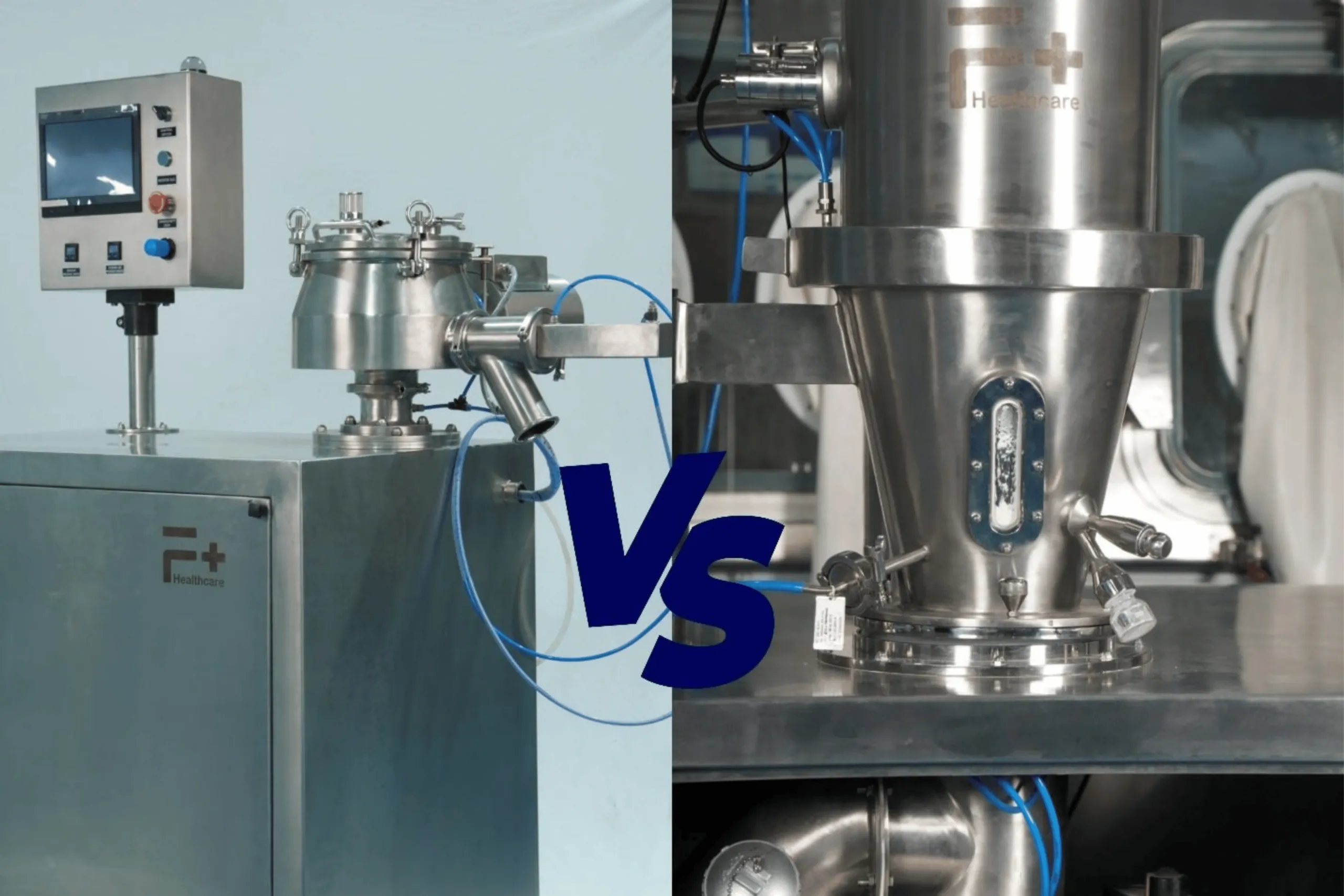
Granulation is a critical step in solid dosage manufacturing. However, many tablet manufacturers are confused about which type of granulation equipment is right for their formulation.
In this blog, we shall explain the factors on which the choice of your granulation technique depends. By the end of the blog, you will be sure of the type of granulation to select, depending on your formulation.
As a pharma machinery manufacturer, we believe that, to make an informed choice, you must understand how wet granulation and dry granulation work.
Understanding Dry Granulation:
Moisture/Liquid-free granulation process, where high pressure is used to compress the powder into sheets or slugs, which are then milled into granules. Dry granulation is typically performed via two common dry granulation equipments:
- Slugging presses: Compress powder into large, dense slugs using a tablet press.
- Roller compactors: Compress powder between two rotating rollers to form ribbons.
Read More: An Introductory Guide To The Dry Granulation Process
Advantages of Dry Granulation:
- Simpler process
- No moisture required, making it suitable for hygroscopic or moisture-sensitive drugs
- Less processing time
- Since no heat is applied to the granules, there is a reduced chance of heat degradation.
Limitations of Dry Granulation:
- Granules may be less uniform
- Harder to achieve high-density granules (especially low-dose APIs)
Wet Granulation:
A process where powders are mixed with a liquid binder(water, ethanol, or other solvents) to agglomerate. The wet mass is then dried and milled to form uniform granules.
There are three common granulation equipmentsused for wet granulation:
- High shear granulator: Powders and binder are mixed quickly with strong mechanical forces to form granules.
- Fluid bed processor: Powder particles are suspended in air and sprayed with a binder, forming granules as they dry.
- Screening/sieve method: Moistens powder and passes it through a mesh to form granules, then dries them.
Advantages of wet granulation:
- Produces uniform granules
- Improves tablet strength
- Enhances the porosity of the final product
- Suitable for modified-release formulations
Limitations of wet granulation:
- Expensive process
- Lengthy process
- Increases energy consumption
- Chance of material loss at various stages
- Not suitable for moisture or heat-sensitive drugs
Key difference between wet and dry granulation:
- Liquid binders: Wet granulation needs the addition of a liquid binder ( water or other solvent), while the dry granulation process relies only on mechanical forces.
- Process: As you can understand from the above explanation, wet granulation is a labour and energy-intensive process. It is more time-consuming than dry granulation, since multiple steps are involved in the process. However, in dry granulation, precise control of pressure and feed rates is required.
Read More: Enhancing Granulation with Robust and Efficient High-Shear Mixers
Which granulation is right for your formulation?
Whether to choose wet granulation or dry granulation, or your formulation processing, depends on many factors such as:
- Your API: Before selecting the granulation method, it is essential to check if your API is sensitive to heat or humidity.
- Tablet goals: It is essential to determine the end property of your tablet, such as strength, dissolution, or specific release characteristic.
- Manufacturing setup: Production scale, equipment availability, and cost will also influence your choice.
Read More: An Introductory Guide To Granulation Equipment
The chart below will help you choose the granulation machine that best suits your formulation.

Selecting the right granulation method is critical for consistent, high-quality tablet production. And for choosing a suitable granulation machine, understanding your formulation’s requirements as well as the end goal of your tablet is extremely important.
Read More: Trust In the Best Rapid Mixer Granulator Manufacturer and Supplier
F Plus Granulators:
F Plus Healthcare offers advanced granulation equipment for both wet and dry granulation. Our range of granulation machines includes fluid bed granulator, rapid mixer granulator and high shear mixer. We also offer a fully enclosed, automated granulation system – a closed-loop granulation suite for safe and efficient pharmaceutical production. For smooth and efficient granulation, we supply supporting granulation line machinery such as material handling units, multi-mills, blenders and bin washing systems.