A shift is happening in pharmaceutical manufacturing that doesn’t get nearly enough attention. Emerging markets across Southeast Asia, Sub-Saharan Africa, and Latin America have spent decades being treated primarily as sales territories. Large MNCs would manufacture elsewhere, ship in, and capture margin. That model is quietly breaking down. More and more companies in these regions are pushing into actual production, not just generics, but biologics, sterile injectables, speciality drugs.
The capital problem nobody talks about, honestly
Here’s what most industry commentary glosses over: the traditional greenfield facility path is simply out of reach for most emerging market manufacturers. We’re talking four to six years from investment decision to first validated batch, with capital requirements running into the hundreds of millions.
That timeline doesn’t fit the pace of opportunity. A government tender, a regional supply agreement, a licensing deal with a multinational, these windows don’t wait five years. And the capital stack to fund a conventional facility build? It doesn’t exist for most mid-sized manufacturers in Nairobi, Ho Chi Minh City, or Bogota.
That’s not a criticism; it’s just the reality of where these companies are starting from. That is why modular manufacturing is starting to make real sense, not as a compromise, but as a genuinely better-suited approach for where these businesses actually are.
What modular actually means and what it doesn’t
Modular gets misunderstood. You’re not cutting corners on compliance or reducing the technical rigour of what gets built, you’re changing the sequence.
Instead of designing and building a monolithic facility and then figuring out equipment and validation, a modular approach assembles pre-engineered, pre-validated production units that can be installed faster and scaled as the business grows. The production environment is built in pieces designed to work together, rather than integrated after the fact.
The timeline compression alone is significant. Done well, a modular build can move from investment decision to first validated batch in under two years. For a company trying to get a product to market or fulfil a supply contract, that’s not a marginal improvement; it’s a fundamentally different business case.
But here’s the thing modular advocates often understate: the concept only works if everything inside the modules is right. The equipment, the cleanroom systems, the utilities. A faster build that produces non-compliant output gets you to failure faster.
Equipment decisions carry more weight in a modular build
When you’re designing a facility incrementally, there’s very little room to compensate later for early equipment choices that didn’t hold up.
That is why working with a pharmaceutical equipment manufacturer who understands GMP compliance, not just engineering tolerances, matters more in a modular context than in a conventional build. Equipment that’s properly documented, materials-certified, and designed for cleanability from the start doesn’t just pass inspections. It makes routine manufacturing more predictable and reduces deviations that slow production and attract regulatory attention.
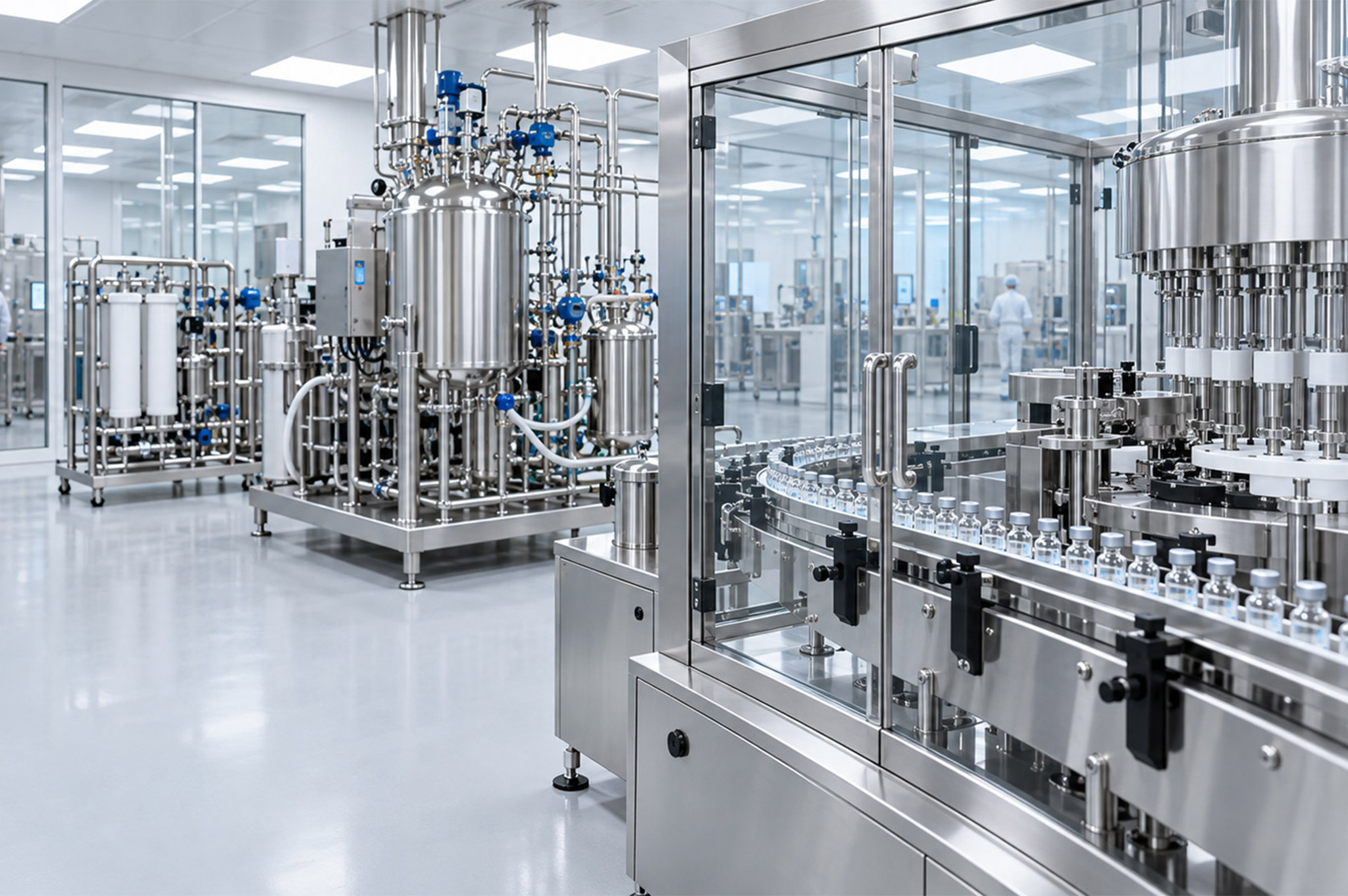
The same logic extends to the broader machinery stack. Sourcing processing equipment piecemeal from five different vendors creates validation complexity that compounds over time. A pharmaceutical machinery manufacturer that can provide integrated solutions across granulation, compression, filling, and packing reduces that complexity considerably. Systems designed to work together commission faster, and when something goes wrong, the troubleshooting is far less complicated.
For companies working across oral solid dosage, liquid preparations, and sterile injectables, equipment selection shapes not just production quality but how smoothly regulatory submissions come together. That’s not an abstraction; anyone who’s sat in a pre-approval inspection knows exactly what this means.
Cleanrooms: the environment is the product
In biopharma, regulatory scrutiny extends to the manufacturing environment itself. ISO classifications, pressure differentials, air change rates, contamination control, inspectors treat these as seriously as they treat the product formulation.
Choosing a pharmaceutical cleanroom equipment manufacturer isn’t a facilities procurement decision, it’s a product quality decision. Laminar airflow units, dispensing booths, pass boxes, air showers, these need to operate as a coordinated contamination control system, not a collection of separately sourced components that were installed around the same time.
In a modular build, cleanroom equipment designed for standardised installation offers a practical advantage. Qualification cycles move faster, inspection outcomes are more consistent and if the business eventually scales to multiple sites, which is often the goal, the ability to replicate a validated environment is enormously valuable.
Water systems: where audits quietly fall apart
Talk to regulatory consultants who work across emerging market biopharma sites, and water systems come up again and again as a failure point. Purified Water, Water for Injection, Clean Steam; these are foundational to nearly every process, and they’re scrutinised closely in audits.
It’s not just about the generation equipment. Inspectors look at the entire storage and distribution loop. Temperature, conductivity, bioburden monitoring, loop design, drainage, everything. A site that invests heavily in production equipment but neglects the water utility will face regulatory problems.
Selecting a qualified pharmaceutical water system manufacturer, one who can design and validate to USP, EP, or WHO standards across the full system, is not optional in any serious facility build. F Plus Healthcare’s water systems range covers purified water generation, multi-column WFI distillation, pure steam generators, CIP/SIP systems, and steam steriliser autoclaves, each designed with scalability built in so the utility can grow alongside capacity rather than getting retrofitted under pressure.
What actually separates the companies that make it
The emerging market biopharma manufacturers that build lasting competitive positions over the next ten years won’t necessarily be the ones with the largest facilities. They’ll be the ones that moved intelligently, faster to market, smarter about validation, and with compliance built into their infrastructure from day one rather than added later when problems surfaced.
Modular manufacturing is a path to that outcome. But it delivers only what it promises when the equipment, cleanroom environment, processing lines, and water systems are sourced from partners who genuinely understand pharmaceutical manufacturing at a technical and regulatory level.
Conclusion
The demand exists. The talent in these markets is real and growing. The regulatory ambition, India’s expanded manufacturing base, Indonesia’s push into biologics, and Kenya’s pharma investment drive are increasingly concrete. What’s been missing is a practical, capital-efficient route to production that doesn’t sacrifice compliance. Modular manufacturing, backed by the right partners across the full infrastructure stack, is that route.
At F Plus Healthcare, we’ve built our offering around processing equipment, cleanroom systems, water utilities, and filling lines, designed to work together for exactly this kind of facility build. If you’re working through plans for a new site or expanding an existing one, we’re happy to get into the specifics with you.
Reach out to our team and let’s start the conversation.
FAQs
1. Why is modular manufacturing gaining traction in emerging markets like Southeast Asia, Africa, and Latin America?
Emerging market pharmaceutical manufacturers often lack the capital and time required for conventional facility builds. Modular manufacturing offers a capital-efficient, faster-to-market alternative without compromising GMP compliance. It aligns with the pace of real business opportunities: government tenders, regional supply agreements, or MNC licensing deals that simply can’t wait five years for a facility to be ready.
2. What role does pharmaceutical equipment selection play in a modular facility build?
Equipment decisions carry significantly more weight in a modular build because there’s little room to compensate for poor early choices later. Equipment must be properly documented, materials-certified, and designed for cleanability from day one. Sourcing an integrated machinery stack – covering granulation, compression, filling, and packing from a single pharmaceutical machinery manufacturer – reduces validation complexity, speeds commissioning, and simplifies troubleshooting.
3. How important are cleanroom systems and water utilities in pharmaceutical manufacturing compliance?
Extremely important. Regulatory inspectors treat the manufacturing environment ISO classifications, pressure differentials, and air change rates as seriously as the product itself. Similarly, water systems (Purified Water, Water for Injection, Clean Steam) are among the most common audit failure points in emerging market biopharma facilities. Both cleanroom equipment and water systems must be designed as integrated, validated solutions, not assembled from separately sourced components
4. What separates successful emerging market biopharma manufacturers from those that struggle?
The manufacturers that build lasting competitive positions aren’t necessarily those with the largest facilities. They’re the ones that moved faster to market, validated intelligently, and built compliance into their infrastructure from day one. Modular manufacturing enables this but only when the full infrastructure stack (processing equipment, cleanroom systems, filling lines, and water utilities) is sourced from partners who understand pharmaceutical manufacturing at both a technical and regulatory level.