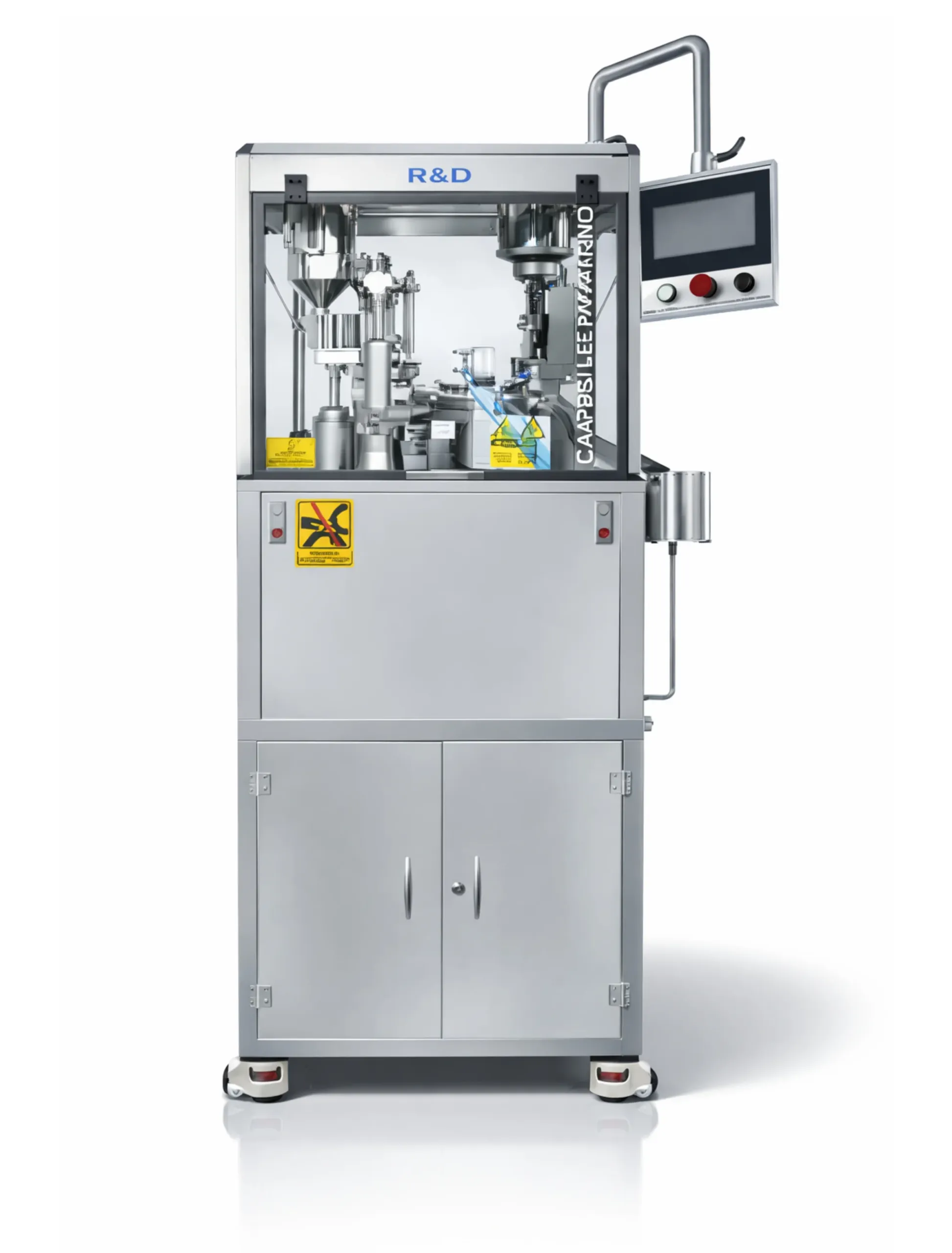

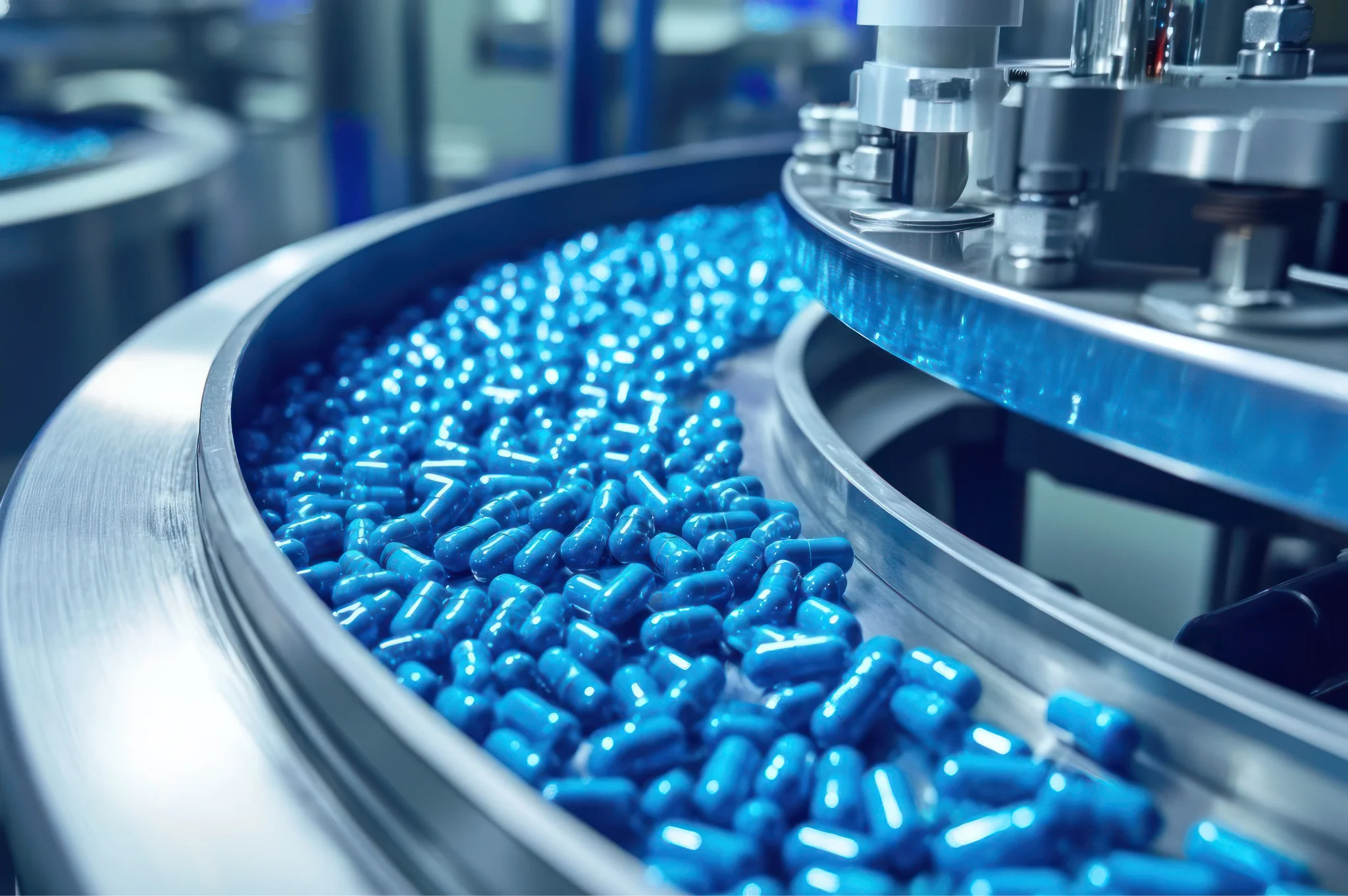
Encapsulation is one of the most trusted and versatile dosage forms in pharmaceutical manufacturing. Behind each capsule lies a carefully engineered process. This process has evolved from simple manual machines to fully automated, high-speed capsule filling lines.
Understanding the full spectrum of capsule filling technology is essential for any pharma manufacturer or even R&D scientists to make smarter decisions during manufacturing. In this blog we have explained the different capsule filling machines. By the end of the blog, you will be confident to choose the right kind of encapsulation machine for your processes.
The Encapsulation Spectrum
There are different kinds of capsule filling machines available. However, each encapsulation technology, follow the same fundamental steps:
Fundamental Steps of encapsulation technology
Capsule Orientation (Rectification)- Separation – Dosing & Filling – Closing – Ejection
The real difference in each of the capsule filling machines lies in the level of control, speed, and automation. Let us understand each of them in detail for you to make an informed choice.
Manual Capsule Filling Machines:
For small-scale operations, compounding pharmacies, or even nutraceutical startups, the manual capsule fillers are often the entry point. These machines are simple in design, easy to dismantle, and operated without requiring skilled labour
Manual capsule filling machines can deliver up to 60,000 capsules in an 8-hour shift. These machines are not built for high volume but they are built for flexibility and accessibility.
Semi-Automatic Capsule Filling Machines
With growing production requirements, pharma professionals often shift to the semi-automatic range. This encapsulation machine reduces operator workload without demanding a full jump to high-speed automation. They are particularly valuable for manufacturers running multiple SKUs at lower volumes, or those scaling up from R&D without yet justifying the investment in full automation.
In semi automatic capsule filling machines, there are two types primarily available – Single Loader and Double Loader. Single loader (SL) machines are well-suited for operations where batch sizes are moderate and flexibility is important. Double loader (DL) machines are apt for pilot-scale and scale-up environments, where speed and consistency become critical.
Automatic High-Speed Capsule Filling Lines:
Fully automatic machines today represent the backbone of modern pharmaceutical production. These machines integrate multiple operations such as orientation, filling, closing, into a continuous cycle with tight process control.
Modern automatic capsule fillers operate on the slug dosing principle: a tamping method where powder is compressed into a soft plug (slug) before being transferred into the capsule body. This guarantees better yield and consistency.
Read More : Efficient and accurate, fully automatic capsule filling machine for the pharma industry
The XTR Series
The XTR series are designed not just to fill capsules, but to handle complexity at scale. These machines are designed to handle heat-sensitive powders and low-dose APIs with minimal wastage.
These capsule fillers achieve a level of filling accuracy that standard tamping systems simply can’t match. Partial filling capability starts as low as 15 mg for capsule sizes 000 through 5. Then, mechanical changeover takes under an hour.
Containment Capsule Filling
Highly potent compounds and cytotoxic formulations require an entirely different approach to encapsulation. These systems are specifically designed for handling highly potent APIs (HPAPIs),where even minimal exposure can be dangerous.
The containment capsule filling line has HEPA filtration, rapid transfer ports (RTP), glove ports, and a negative-pressure environment to guarantee least exposure. Additionally, to enable full containment of the production line, the containment series seamlessly integrates check weighers, metal detectors, and de-dusters.
Liquid Capsule Filling:
Liquid capsule filling is the process of filling liquid or semi-solid formulations into hard capsules (typically hard gelatin or HPMC shells), followed by sealing to prevent leakage. Liquid filling is great for API’s that don’t perform well as powder.
These capsule filling machines are available in different ranges: R&D scale (1,000–4,000 capsules/hour) to commercial scale (up to 70,000 capsules/hour).
The Ancillaries
A capsule filling machine never operates in isolation. It is part of a production ecosystem.A well-integrated encapsulation line typically includes empty capsule sorter elevator, product transfer system,check weigher, metal detector, de-dusting and polishing machine and a filled capsule elevator unit. Each of these components contributes directly to line efficiency, product quality, and regulatory compliance.
Read More : Peripheral equipment for automatic capsule fillers machine
Choosing the Right Machine
When selecting a capsule filling system, the machine’s output number is often the first thing buyers look at. However, it should not be the only thing.
The choice of the machine should be highly dependent on your batch size, formulation characteristics, regulatory requirements, containment needs and throughput targets.
Read More: Choosing the Right Capsule Filling Machine: A Complete Guide for R&D, Pilot, and Production Scale.
Conclusion:
Encapsulation has come a long way, from a technician hand-filling shells at a bench to fully automatic high-speed SCADA-integrated capsule filling lines.
But across every point on that spectrum, the fundamentals haven’t changed: fill accuracy, yield, compliance, and operator safety.
Today, there is a matching technology to any of your encapsulation needs, whether you are validating a new formulation, scaling up or optimising your existing line. You just need to match the tight technology to your stage.
At F Plus Healthcare, we never lead with machine specifications. As a renowned pharma machinery manufacturer, we start with your formulation, your facility, and your future. Interested in finding the right capsule filling solution for your facility? Explore our full encapsulation range or contact us at daanesh@fplushealthcare.com or on WhatsApp at +91 75062 17809.
FAQs:
1. What are the different types of capsule filling machines?
Capsule filling machines are broadly categorized into manual, semi-automatic, and fully automatic systems. Additionally, specialized machines such as liquid capsule fillers and containment capsule filling systems are used for specific formulations and safety requirements.
2. How do I choose the right capsule filling machine for my operation?
The right machine depends on factors like batch size, formulation type, production scale, containment requirements, and desired output. Small-scale or R&D setups may benefit from manual or semi-automatic machines, while large-scale production typically requires fully automated systems.
3. What is the difference between single loader and double loader semi-automatic machines?
Single loader machines are ideal for moderate batch sizes and flexible operations, whereas double loader machines offer higher productivity and are better suited for pilot-scale and scale-up environments where speed and consistency are critical.
4. Why is containment important in capsule filling?
Containment is crucial when working with highly potent APIs (HPAPIs) or cytotoxic compounds. It ensures operator safety and regulatory compliance by minimizing exposure through features like negative pressure systems, HEPA filtration, and glove ports.
5. Can capsule filling machines handle liquid formulations?
Yes, specialized liquid capsule filling machines are designed to fill liquids and semi-solids into hard capsules. These are especially useful for APIs that are unstable or ineffective in powder form and are available for both R&D and commercial-scale production.